A Reassessment of the Historical Range of Beaver in California and Implications for Salmonids


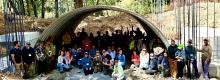
(Photo by Cheryl Reynolds, Worth A Dam)

North American beaver (Castor canadensis) have been shown to have beneficial effects on salmonids, particularly in the arid West. Positive effects include creation of oversummering habitat (beaver ponds) for first year fish, conversion of seasonal streams to perennial, removal of sediments and pollutants via wetland creation, etc. Beaver are widely regarded as non-native in the Sierra Nevada, the San Francisco Bay Area proper, and coastal central and southern California. However, there are no recent reviews of the evidence for or against the historical range of beaver in California.

A review and integration of multiple lines of evidence, including historical naturalist and fur trapper records, oral histories, museum specimens, ethnographic material such as pictographs and ceremonial items, evaluation of habitat suitability, as well as radiocarbon dating of remnant beaver dams was conducted.

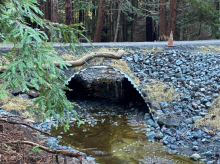
Early naturalist records suggest that beaver were present as far south as San Diego, and accounts of fur trappers suggest that beaver were present in the San Francisco Bay Area. Oral histories place beaver in the high Sierra in the Kings River and Carson River watersheds. Museum specimen records include beaver collected in 1855 in Santa Clara, California and in 1906 in Sespe, California by experienced collectors. Native American pre- European contact words for beaver exist for eastern and mountain Sierra Nevada tribes including the Washoe and Mountain Maidu. The authenticity of the Sespe Creek specimen is supported by the presence of a Chumash pictograph of a beaver at Painted Rock in the Cuyama watershed in the Sierra Madre mountains, about 35 miles from the Sespe Creek headwaters. A historical Chumash shaman’s rain making kit made from the skin of a beaver tail was also collected near this area in the Sierra Madre. Suitability of habitat in California is established based on the 70-year success of beaver re-introductions in the Sierras, the Bay Area, coastal California, and southern California including Santa Barbara, Riverside and San Diego Counties. Finally, radiocarbon dated remains of a remnant beaver dam in Red Clover Creek above 4,500 feet in the Sierras suggest beaver were present in the high Sierra until 1850 A.D.

The presence of beaver may be up to 80 times more efficient than large, woody debris in promoting salmon reproductive success. Grinnell’s 1937 assertions that beaver were only present in the Pit and Klamath River drainages (C. c. shastensis), the Central Valley (C. c. subauratus) and the Colorado River (C. c. repentinus), appear to be based on contemporary trappers’ interviews and an incomplete review of museum specimen records. New information suggests that beaver were once widespread in much, if not most, of California, and the success of the circa 1940 re-introductions throughout the state for 70 years confirms that habitat is suitable in coastal streams (Big River (Mendocino County), Pescadero Creek (San Mateo County), Santa Ynez River (Santa Barbara County), Santa Margharita River (Riverside and San Diego Counties), Lake Tahoe and Yosemite). The States of Utah and New Mexico have formal plans to reintroduce beaver to restore streams and fish habitat. Although it cannot be proven that beaver were present statewide in California, an integration of the findings here suggests that beaver were native to much of the state, contrary to previous assertions.