Hundreds of Restorationists Congregate at the Annual Salmonid Restoration Conference

2009_summer_carmelriver.jpg
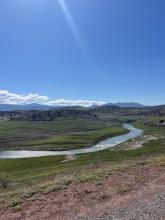
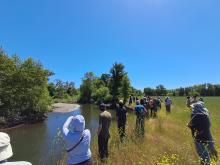
Participants in the Carmel River Restoration Tour visited the Carmel River estuary and the San Clemente Dam that impedes steelhead fish passage and is so choked with sediment that it does not even provide drinking water. (Photo by Michael Wellborn)

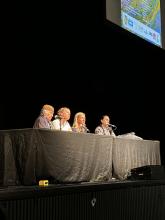
Salmonid Restoration Federation hosted the 27th Annual Salmonid Restoration Conference last spring in Santa Cruz, California. Hundreds of participants attended from all over the state despite this time of severe budget cuts and travel freezes. Interestingly, the stop work order and agency travel freezes affected the demographics of conference attendees. The location, agenda, and the economic landscape brought out the grassroots restoration and watershed community. The conference was primarily attended by restoration practitioners and non-profits as well as students, watershed stewards project members, private landowners, agency personnel, and county staff. This is regarded as the premiere habitat restoration conference in the Pacific Northwest and hosting the conference in Santa Cruz afforded wonderful opportunities to view projects on the Central Coast and highlight issues that pertain to coastal watershed and coho salmon recovery.

2009_summer_sanclementedam.jpg
(Photo: Sean Carlson)

The conference featured workshops on topics including Estuary Restoration, Fish Passage Design and Implementation, Coho Use and Restoration of Offchannel Habitat, Watershed Monitoring and Assessment, and Sustainable Agriculture: Water Quality and Riparian Habitat Restoration. All day field tours included tours highlighting Resource Management for Steelhead and Coho Salmon Conservation in Santa Cruz county: a Tour of San Lorenzo River and Soquel Creek projects, Carmel River Restoration Projects, Southern Coho Streams and the NOAA lab and Broodstock program, Coho Salmon and Steelhead Enhancement Projects on the Santa Cruz North Coast, Dams and Daylighting: Progress and Opportunities in San Francisquito Creek and half-day tours of fish passage projects and sustainable agriculture projects in conjunction with those morning workshops.

2009_summer_soquelcreek.jpg
Soquel Creek Estuary (Photo: Sean Carlson)

The Plenary session featured Dr. Peter Moyle and Dr. Josh Israel from UC Davis who discussed the state of California salmonids in California, Mike Furniss from Redwood Sciences Lab who addressed climate change and salmonid recovery, Dr. Astrid Scholz of Ecotrust presentated on how marine ecology and oceanic conditions affect salmonids, and Dr. Bob Curry of Watershed Systems highlighted the status of restoration efforts in Monterey Bay and adjacent watersheds.

2009_summer_beancreek.jpg
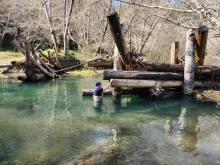
Shawn Chartrand, principal of Balance Hydrologics, speaks on the importance of large downed wood in the morphology of Central Coast streams, during the Resource Management for Steelhead and Coho Salmon Conservation in Santa Cruz County field tour. This stop was on Bean Creek, tributary to the San Lorenzo River. (Photo: Jodi Frediani)

Concurrent sessions addressed biological, policy, and environmental and physical issues affecting salmonids. Concurrent sessions included the following topics: Water Diversions & Water Wars in California; FERC Relicensing Restoration Opportunities; Central & South Coast Steelhead: Biology, Genetics, and Recovery Strategies; Fire Ecology, Forests, and Fisheries; Dam Removal and Modifications for Salmonid Recovery; Restoration at the Crossroads; Juvenile Steelhead and Coho Salmon: Central Coast Habitat and Population Research; Hydrologic and Geomorphic Legacy Issues: Solutions for the Past and the Future; Coho Salmon Recovery and Restoration: Putting Theory into Practice.

The 28th Annual Salmonid Restoration Conference will be held in Redding, CA next March 10-13 and SRF will be posting the call for abstracts later this summer. The Redding conference will showcase large-scale restoration efforts on the Trinity and Sacramento Rivers as well as innovative projects on Battle, Clear and Cow Creek.